
batterien
Lithium-Eisenphosphat-Batterie
Prozesslösung
Bei LFP-Batterien muss eine Eisenphosphatquelle hinzugefügt werden. Abhängig von den geforderten Eigenschaften werden Additive hinzugefügt; dies gilt insbesondere bei LFPs, da diese eine geringe elektrische Leitfähigkeit aufweisen. Auf diesem Grund muss eine Kohlenstoffquelle integriert werden, wie z. B. Rohrzucker.
Eigenschaften von LFP
LFP zeichnet sich aufgrund seiner Olivin-Struktur durch große strukturelle und thermische Stabilität aus, dadurch ist Eigensicherheit gewährleistet. Weiterhin ist LFP reichlich vorhanden und umweltfreundlich.
Es gibt jedoch auch einige Nachteile. LFP weist eine niedrige Energiedichte auf, begrenzt durch niedrige Spannung und eine niedrige Entladungsrate, die begrenzt sind durch eindimensionale Ionenleiter und eine schlechte elektrische Eigenleitfähigkeit.
Die Lösung für diese Probleme ist die Verkleinerung der Partikel bis in den Nanometerbereich, wofür Rührwerkskugelmühlen wie ZETA, Discus, etc. eingesetzt werden können. Die Reduzierung der Größe kann zur Bewältigung der kinetischen Probleme beitragen. (Li+-Diffusion innerhalb des Partikels).
Denn die Ionen-Diffusionskonstante ist abhängig von der Partikelgröße. Für schnelle Lade- und Entladevorgänge in der Batterie ist es von entscheidender Bedeutung, dass der Transport der Elektronen und Lithium-Ionen schnell abläuft. Wenn die Partikelgröße bei LFP so klein ist, dass sie sich im Nano- oder Sub-Mikrometer-Bereich bewegt, ist ein größerer Anteil von Kohlenstoffadditiven erforderlich, um alle Aktivmaterialien miteinander zu verbinden.
Produktionsprozess von LFP (Lithium-Eisenphosphat)
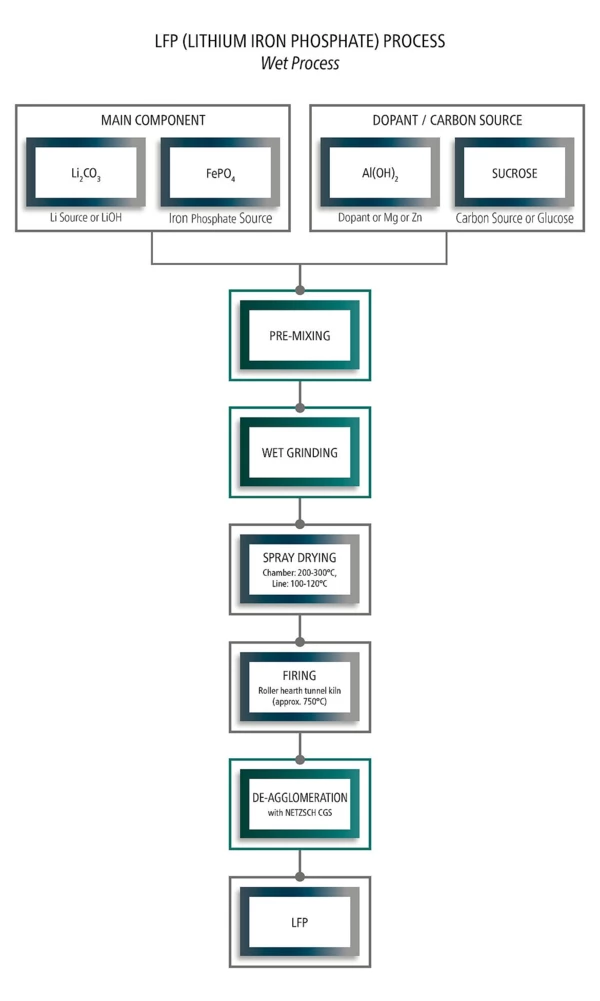
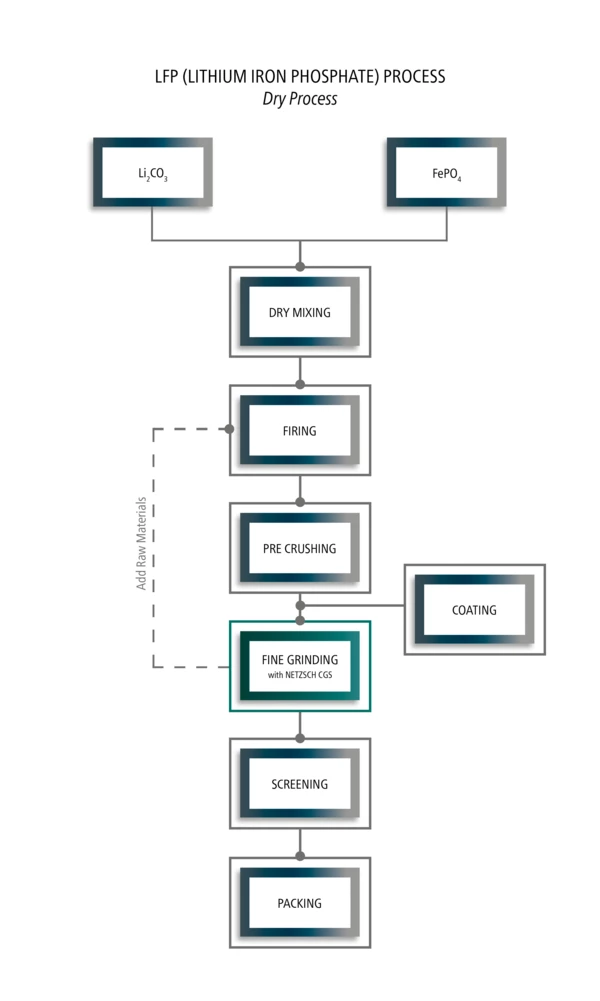
Analyzing Solution
Unlike Lithium-ion batteries, Lithium Iron phosphate batteries (LFP Batteries) are composed of lithium, phosphoric acid, and iron.
Unlike nickel and cobalt materials, phosphoric acid and iron materials have benefits in terms of price, so this is one of the batteries that have been actively researched and developed. However, the key is to increase the energy density of LFP batteries because of the disadvantage of low energy density.
NETZSCH Analyzing Solution provides a solution to energy efficiency.
Each time a material is exposed to temperature changes – it shows a variation in its dimension. Whether it is in the course of its regular thermal expansion or by passing a phase transition, the substance will either be shrunk or elongated. For example, polymer separators can shrink significantly at elevated temperatures which affects the battery performance. To predict the deformation and stresses in the separator in battery cells, it is necessary to measure the expansion/shrinkage behavior. This is achieved by Thermomechanical Analysis (TMA), expressed by the coefficient of thermal expansion (CTE).
Measuring the thermal diffusivity and thermal conductivity along with the specific heat capacity form the basis for comprehensive understanding. To investigate these thermophysical properties, NETZSCH offers Laser/Light Flash Analysis systems (LFA) as well as systems for Differential Scanning Calorimetry (DSC). Thermal management system failures can be avoided.
The STA 449 Jupiter series combines configuration flexibility and unmatched performance in just one instrument. Pluggable inter-changeable DSC and TGA sensors and various furnaces allow for precise thermoanalytical measurements. By supplementary MS coupling, even more comprehensive analyses are possible.
We know empirically that batteries have a fever while we use or charge laptops, cell phones, etc. In other words, the batteries emit some energy to heat during charging and discharging. If the heat generated at this time is small, it can be seen that electric energy is efficiently charged and discharged without heat loss. Measuring the thermal energy generated at this time can calculate the efficiency of the battery during charging and discharging process.
With MMC 274 Nexus, thermal energy generated during charging and discharging process of the coin cell batteries can be measured.