Produktion von Zellen/Modulen/Packs
Sicherheit & Effizienz
Ein gutes Batterie-Wärmemanagement garantiert eine längere Lebensdauer, da es dafür sorgt, dass die Temperatur der Zellen während Lagerung, Betrieb und beim Laden innerhalb eines begrenzten Temperaturbereichs bleibt. Um zu verstehen, wie viel Wärme die Zelle abgeben können, müssen wir die grundlegenden Wärmeübertragungseigenschaften der Zelle kennen.
Elektrolyte zeichnen sich durch ihre hohe Leitfähigkeit aus sowie durch gute elektrochemische Stabilität und ihre Leistungsfähigkeit bei niedrigen Temperaturen. Die thermische Stabilität vieler Elektrolytlösungen ist jedoch sogar bei gemäßigten Temperaturen begrenzt. Durch Überladung können Batterien so stark überhitzen, dass sie sich entzünden. Neben verschiedenen Metallen (z. B. Co, Al, Mg etc.) enthält das Kathodenmaterial von Lithium-Ionen-Batterien Nickel. Es besteht eine positive Korrelation zwischen dem Nickelgehalt und der Batteriekapazität. Nickel verringert jedoch die Stabilität, da es leicht mit der Umgebung reagiert. Der Nickelgehalt kann die Stabilität beeinträchtigen und dies muss verbessert werden, um die Sicherheit zu garantieren.
Für eine Verbesserung von Effizienz, Leistung und Lebensdauer der Batterie ist insbesondere das Verständnis der Wärmeerzeugung während der Lade-/Entladezyklen von entscheidender Bedeutung. Die Messung der thermischen Signatur von Knopfzellen während des Betriebs gibt Einblicke in die zugrunde liegenden Prozesse und bietet eine quantitative Methode für den Vergleich von chemischen Veränderungen, die über Strom- und Spannungsmessungen hinausgeht. Die Menge der während all dieser physikalisch-chemischen Veränderungen freigesetzten oder aufgenommenen Wärme und die Temperaturveränderungsrate in der Knopfzelle stellen ein weiteres Puzzleteil dar und können zur Beschleunigung des Entwicklungsprozesses beitragen.
Analyzing Solution
Each time a material is exposed to temperature changes – it shows a variation in its dimension. Whether it is in the course of its regular thermal expansion or by passing a phase transition, the substance will either be shrunk or elongated. For example, polymer separators can shrink significantly at elevated temperatures which affects the battery performance. To predict the deformation and stresses in the separator in battery cells, it is necessary to measure the expansion/shrinkage behavior. This is achieved by Thermomechanical Analysis (TMA) and Dilatometer (DIL), expressed by the coefficient of thermal expansion (CTE).
Measuring the thermal diffusivity and thermal conductivity along with the specific heat capacity form the basis for comprehensive understanding. To investigate these thermophysical properties, NETZSCH offers Laser/Light Flash Analysis systems (LFA) as well as systems for Differential Scanning Calorimetry (DSC). Thermal management system failures can be avoided.
The STA 449 Jupiter series combines configuration flexibility and unmatched performance in just one instrument. Pluggable inter-changeable DSC and TGA sensors and various furnaces allow for precise thermoanalytical measurements. By supplementary MS coupling, even more comprehensive analyses are possible.
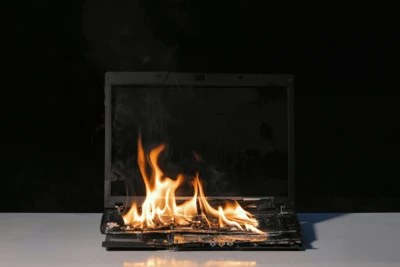
We know empirically that batteries radiate heat while we use or charge laptops, cell phones, etc. In other words, the batteries emit some energy to heat during charging and discharging. If the heat generated at this time is small, it can be seen that electric energy is efficiently charged and discharged without energetic losses. Measuring the heat generated at this time can calculate the efficiency of the battery during charging and discharging process.
With MMC 274 Nexus, heat generated during charging and discharging process of the coin cell batteries can be measured. The heat generated during the charge and discharge process as specified below was measured using LiR 2032 and pouch type, which is one of the general-purpose lithium-ion batteries.
With the isothermal temperature maintained at 25℃, the coin cell is charged a constant current of 45mA up to a cutoff voltage of 4.2V(①), In the subsequent relaxation phase(②), the coin cell and the sensor return to thermal equilibrium. The discharging phase is limited by the cutoff voltage of 2.5V and is again followed by a relaxation phase(④)
At this time, the current and voltage signals are transferred from the battery cycling equipment to the NETZSCH Proteus software.
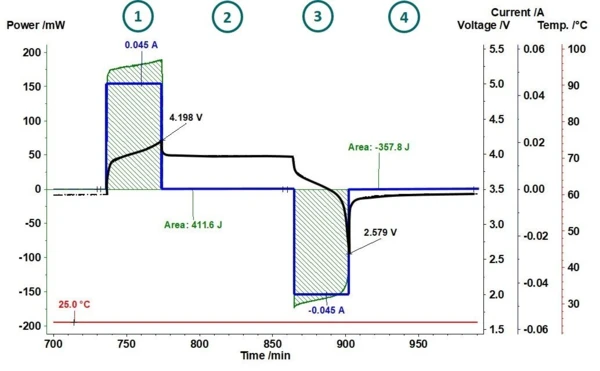
Thus, to calculate the energy lost during charging and discharging, the power input and the emitted heat could be calculated independently in the charging and discharging steps, and the proportion of the power input to the emitted heat could be represented in this way.
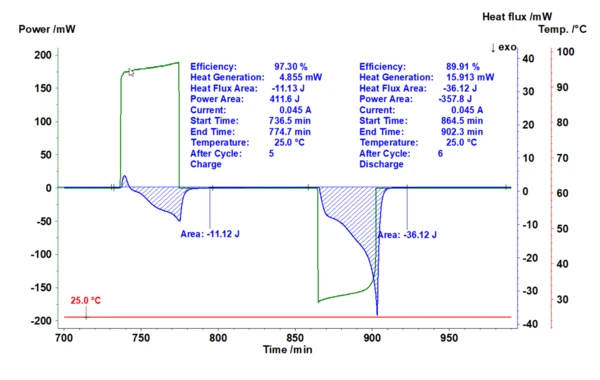
The figure on the left shows how the area evaluation of the heat flux during the charging process automatically calculates the input power (411.6 J) and the heat flux signal (-11.12 J) and the ratio of the two values.
As a result, it was confirmed that the efficiency was 97.3% during the charging process, and was only 89.9% due to the higher calorific value (35.12 J) in the discharge after that.
Accelerated Rate Calorimeter (ARC) is an instrument capable of measuring at which temperature a battery causes an explosion reaction. It is possible to measure the explosion reaction of a sample larger than MMC (up to 18650 batteries).